You are here
 Lonchaeidae (2)
 Dasiopiniae (1)
- Lonchaeinae (10)
- Chaetolonchaea (8)
- Earomyia (23)
- Fulgenta (15)
- Hydrolysa (2)
- Lonchaea (235)
- Lamprolonchaea (17)
- Neosilba (40)
 Neosilba amphora
- Neosilba angusta
- Neosilba batesi
- Neosilba bella
- Neosilba bifida
- Neosilba certa
- Neosilba concava
- Neosilba convexa
- Neosilba cornuphallus
- Neosilba delvechioi
- Neosilba dimidiata
- Neosilba distospinosa
- Neosilba fuscipennis
- Neosilba glaberrima
- Neosilba ilheuense
- Neosilba inesperata
- Neosilba laura
- Neosilba longicerata
- Neosilba major
- Neosilba mcalpiniei
- Neosilba nigrocaerulea
- Neosilba oaxacana
- Neosilba orbata
- Neosilba pantanense
- Neosilba paramerolatus
- Neosilba parapeltae
- Neosilba parva
- Neosilba peltae
- Neosilba pendula
- Neosilba perezi
- Neosilba piracea
- Neosilba plana
- Neosilba pradoi
- Neosilba pseudobifida
- Neosilba pseudopendula
- Neosilba pseudozadolicha
- Neosilba spiculata
- Neosilba tolimensis
- Neosilba turgidiphallus
- Neosilba zadolicha
- Priscoearomyia (13)
- Silba (117)
Neosilba concava Galeano-Olaya & Canal
Nomenclature
-
Tribe: LonchaeinaeGenus: Neosilba




SUMMARY
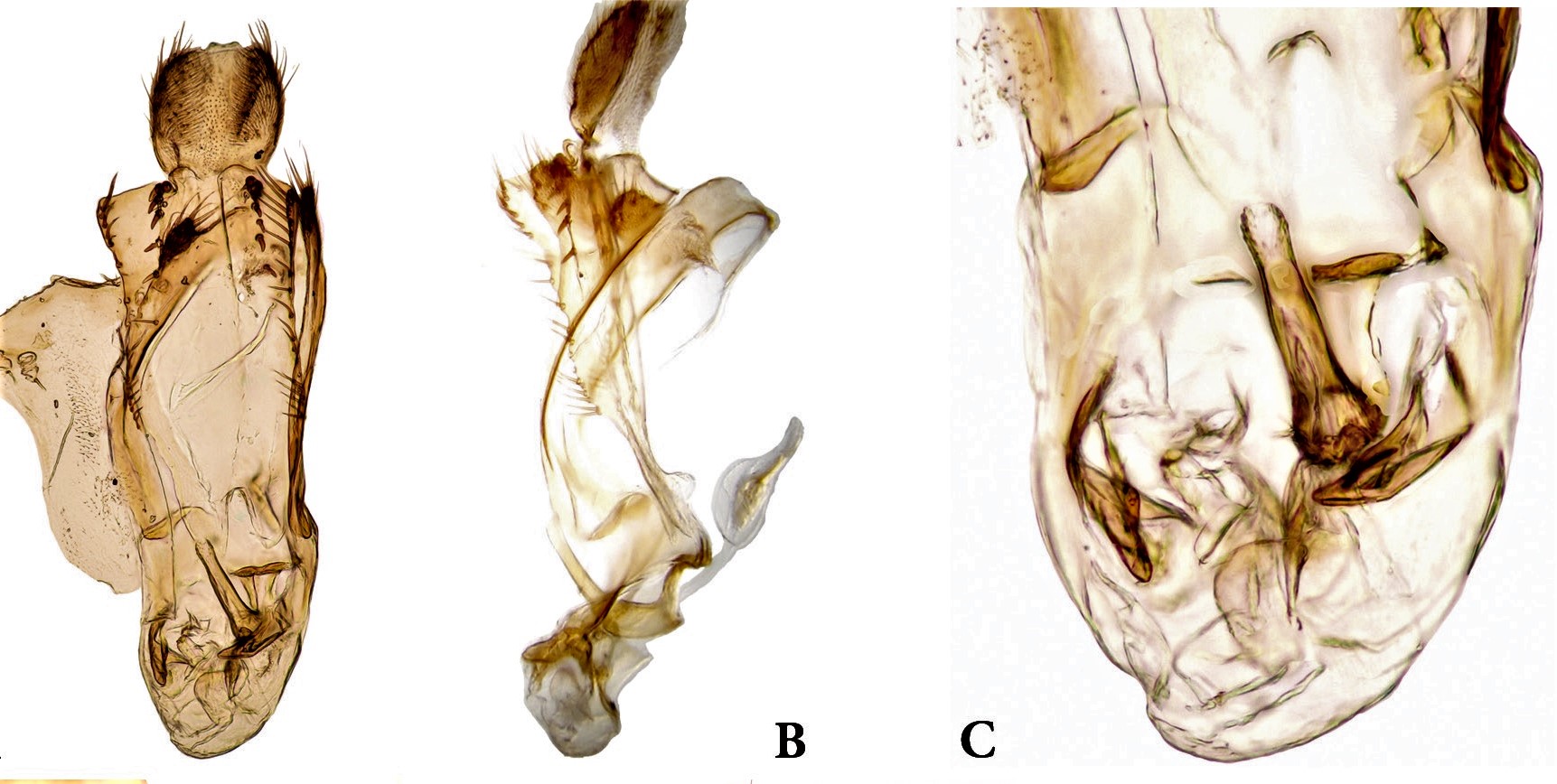
Diagnosis: Neosislba concava belongs to the peltae species group characterized according to data of the previous species. The new species could be recognized because the junction of the filament and the C of the aedeagus is not clearly wider (Fig. 5D), filament spiculated just at the apex and base (Fig. 5D), by the 17 setulae along ¾ apical in the margin of the surstylus, in three groups 6 distally, 5 spaced medial and 6 posterior (Figs. 5A, B, E), and the posterodorsal border of the epandrium concave (Figs. 5B, E);
N. convexa differs by the posterodorsal border of the epandrium rounded; by the 10 equal spaced setulae in the margin of the surstylus and the filament slightly thinner; N. peltae differs by the posterodorsal border of the epandrium being rectangular, 7 setulae in the margin of the surstylus preceded by 4 widely spaced; the filament of the aedeagus is totally spiculated; N. mcalpiniei differs by the apex of the aedeagus being arrow-like shaped; N. parapeltae by the apex of the aedeagus crown-like shaped; N. ilehuense differs by the filament reaching beyond the base of the surstylus.